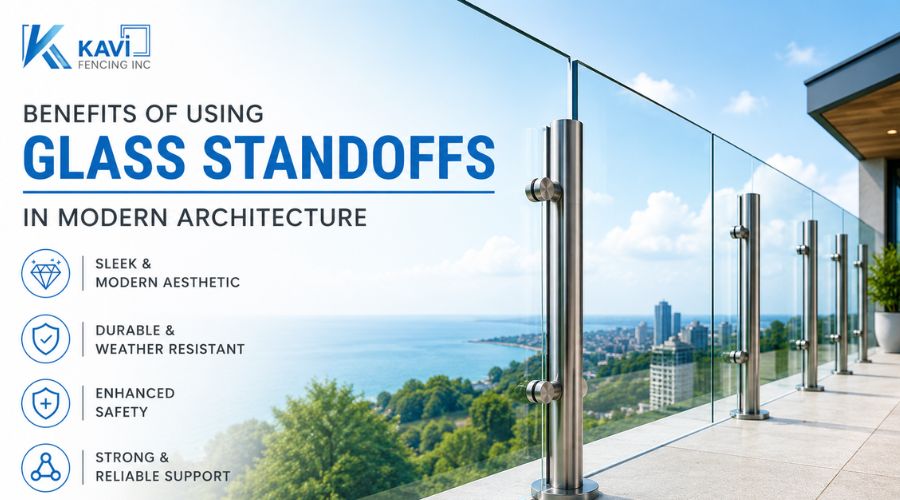
Glass has moved from a secondary building material to the defining feature of modern architecture. Corporate towers, luxury residences, retail storefronts, and hospitality spaces rely on floor-to-ceiling glass to project openness and precision. Driving much of that shift is one simple component: glass standoffs. These load-bearing fittings connect glass panels directly to structural surfaces without bulky frames, producing the clean sightlines that define contemporary design.
Glass standoff fittings fasten to masonry, concrete, steel, or timber substrates and grip the glass at precise mounting points. Architects specify them for glass railings on staircases, balconies, and decks; for curtain wall facades; for office and retail partitions; for balustrades; and for signage systems. For a closer look at mounting configurations, see our guide on the Types of Glass Standoffs.
Modern Aesthetic Appeal
Frameless glass systems earn their place in contemporary architecture because they do not compete with the space they occupy. Where traditional framing fragments sightlines with aluminium profiles, a frameless installation backed by glass standoff fittings lets the glazing dominate. Natural light penetrates further. Rooms read as larger. The surrounding landscape becomes part of the interior.
Corporate offices use this quality to signal transparency and ambition. Shopping malls rely on it to draw the eye toward retail frontage. Hotels specify frameless glass balustrades to keep panoramic views unobstructed. Luxury residential developers use glass standoffs on cantilevered staircases and roof terraces precisely because the hardware disappears, leaving only the glass.
High Strength and Durability
Stainless steel construction gives glass standoffs a performance profile that most architectural hardware cannot match. It resists corrosion from salt air, humidity, and industrial pollutants, making these fittings suited to coastal facades and open balconies where zinc-plated hardware would degrade within a few years. Each standoff distributes load at a defined contact point rather than concentrating stress along a continuous frame edge. Heavy-duty glass mounting systems built this way maintain clamping torque through years of thermal cycling. Corrosion-resistant fittings and durable architectural hardware from quality manufacturers hold tolerances from cold winter facades to sun-exposed canopy structures, delivering long-term reliability without warping or seal failure.
Easy Installation and Low Maintenance
Traditional framed systems demand precise alignment across the full panel perimeter. Glass standoffs reduce that to four or six discrete mounting points per panel. Installers drill, anchor, and torque each fitting independently, cutting labour time and reducing alignment risk. Individual panels are replaceable without dismantling adjacent sections. On the maintenance side, the hardware is placed at the glass edge rather than behind profiles that trap dust and moisture. There are no frames to re-seal and no gasket tracks to clear. Over a 10 to 15-year lifecycle, lower maintenance requirements and easy panel replacement produce cost savings that justify specifying quality standoffs from the outset.
Versatility Across Architectural Applications
Glass standoff fittings are used in a variety of project types. The same fitting geometry is used by architects to design custom layouts for different types of buildings.
Commercial buildings: Facade-mounted standoffs support curtain wall glazing across multiple storeys without continuous structural framing.
Residential interiors: Internal balustrades and partitions keep open-plan sightlines clear while complying with building code requirements.
Glass canopies: Overhead panels fixed to steel or concrete sub-frames shelter entrances without the bulk of traditional framed systems.
Office partitions: Designers reconfigure layouts by relocating individual panels rather than removing full framing systems.
Retail storefronts: Standoff-fixed shopfronts project a transparent, premium appearance that frames merchandise displays without obstruction.
Signboards: Standoffs mount glass and acrylic signage away from walls, creating a shadow gap that adds depth and a professional finish.
Customization Options for Glass Standoffs take this versatility even further. Non-standard glass thicknesses can be accommodated with custom sizes. Finish options include satin polish, mirror polish, brushed, and colour coatings in black, gold, and bronze. Flush, protruding, and recessed mounting configurations are available to suit different substrate conditions, offering design teams the flexibility to keep a consistent material language throughout every detail.
Enhanced Safety and Structural Support
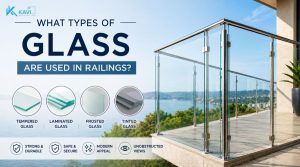
Secure glass fixing systems depend on consistent clamping force and accurate load distribution, both of which precision-machined standoffs deliver reliably. Each fitting grips the glass through a neoprene or EPDM buffer that spreads the clamping load and prevents point stress concentrations under dynamic loading or thermal movement. Architectural safety fittings at this level are compatible with both toughened tempered and laminated glass. Specifying either in combination with structural glass support hardware that holds its torque over time produces installations that meet the safety requirements of high-occupancy commercial spaces and residential balustrade codes. The load path runs from the glass panel, through the standoff, and into the substrate, with no reliance on adhesives or sealants that degrade over time.
Why Choosing the Right Glass Standoff Manufacturer Matters
Material quality and precision manufacturing separate standoffs that perform for decades from those that corrode or lose torque within a few years. A glass standoff manufacturer working to consistent dimensional tolerances produces fittings that align predictably during installation, hold clamping loads through thermal cycling, and present a uniform finish across large glazed surfaces. Those outcomes rely on controlled raw material sourcing, machining accuracy measured in fractions of a millimetre, and surface finishing that achieves consistent polish across every production run.
Third-party test documentation on fittings provides specifiers and building inspectors with the confidence of the product’s load and environmental ratings. Reputable manufacturers also offer technical support in the specification process to help teams select the proper size, finish, and mounting configuration for their specific substrate conditions and glass type. That support reduces costly substitutions during installation.
Kavi Fencing Inc. manufactures glass standoffs in stainless steel and brass in a full range of sizes and finishes for high-traffic commercial and precision residential projects. Talk to our expert team about your project requirements.