Staircases, balconies, terraces, decks and other elevated areas require a barrier that provides safety without obstructing views. Railings and balustrades serve this function, and the two terms are frequently used interchangeably. Railings and balustrades differ in construction, the range of design options available, and the requirements for installation.
What Is a Balustrade?
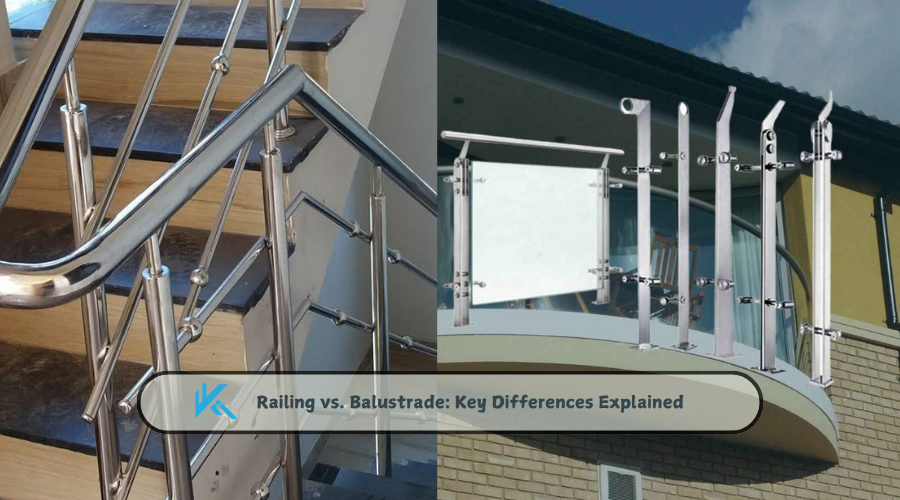
A balustrade is the complete barrier system: handrail, balusters or posts, infill panels, and the fittings that hold everything together. A stainless steel balustrade can use glass, perforated metal, powder-coated metal, or wire infill, giving designers room to match a barrier to the surrounding architecture rather than treating it as a standalone safety add-on.
What Is a Railing?
A railing is a protective safety barrier and hand-support system installed around staircases, balconies, and elevated platforms. The objective is to provide structural support to a functioning handrail, vertical posts, and safety infills like glass panels, wire mesh, or metal bars. The handrail is able to safely support human weight loads while in motion, and the strong anchoring posts fix the whole assembly to the subfloor or building structure beneath.
Railing vs. Balustrade: What Are the Key Differences?
Basic Purpose
A railing provides a handhold and a barrier at height. A balustrade offers the same safety function, but as a coordinated system, the posts, infill and handrail work together.
Construction
Railings are usually built from a handrail and posts, sometimes with minimal infill between them. Balustrades or infill panels are placed between the posts and brackets, and fixings tie the panels into the structure.
Design and Appearance
Balustrades open up more design options. Bright and satin finishes, paired with glass, mesh, or metal infill, suit anything from a corporate lobby to a residential deck. Railings keep a simpler, linear look.
Installation
Railing installation focuses on posts, brackets, and the handrail run. Balustrade installation adds infill panels and their fixings, so the supporting surface, post spacing and panel dimensions need to align before fitting begins.
Applications
Both appear on staircases, balconies, terraces, decks, and patios. Balustrades are more commonly used in commercial spaces, as a continuous glass or metal panel serves as a barrier and a design feature.
Material Options
Stainless steel grades 304 and 316 cover most handrail and balustrade components, with 316 preferred for coastal or high-humidity sites for its added molybdenum content. Glass, wire and perforated metal round out the infill choices.
Maintenance and Durability
Stainless steel resists corrosion indoors and outdoors, reducing maintenance costs over time. Glass infill needs regular cleaning, while wire and perforated metal tolerate outdoor exposure with less attention.
Railing vs. Balustrade: Comparison Table
| Feature | Railing | Balustrade |
| Components | Handrail, posts | Handrail, posts, infill panels, fittings |
| Design flexibility | Limited | Wide range of finishes and infill |
| Typical use | Handhold, simple barrier | Complete architectural barrier |
| Installation | Simpler | More coordination required |
When Is a Railing a Better Choice?
Simple Safety Barrier
When the only requirement is a secure handhold, a railing meets the brief without added infill or panelling.
Minimalist Designs
A clean, uncomplicated appearance suits projects where a railing’s simpler profile works better than a full panel system.
Staircase and Walkway Applications
Staircases and walkways where safe, supported movement matters most rarely need anything beyond a well-fixed railing.
When Should You Choose a Balustrade?
Balcony and Terrace Protection
A balustrade combines safety with visual appeal, ideal for balconies and terraces where the barrier is also part of the view.
Glass Infill Systems
Glass infill keeps sightlines open while meeting safety requirements, a common choice for contemporary balcony and terrace designs.
Custom Architectural Projects
Custom projects get more room for infill material, finish, and configuration with a balustrade than with a standard railing.
Also read: What is a Balustrade on stairs and balcony?
How to Choose Between a Railing and Balustrade?
Base the decision on installation location, safety function, height, layout, and material. Infill requirement, glass compatibility, and indoor or outdoor exposure matter too, alongside design preference, maintenance and applicable safety codes.
What Should You Look for in Stainless Steel Balustrade Manufacturers?
Search for stainless steel balustrade manufacturers that offer consistent material quality, a choice of 304 and 316 grades, and the fabrication capability to customise posts, panels, and fittings to your project’s dimensions. As an established manufacturer, we at Kavi Fencing guarantee long-term structural integrity by providing engineered surface finishes, precision components, and turnkey installation support. Prioritising a manufacturer with a proven track record on comparable engineering projects guarantees code compliance and seamless project execution.
Conclusion
Railings and balustrades both keep people safe around elevated areas, but a balustrade generally builds into a fuller architectural system, with more choice in posts, handrail style, infill, and finish. The right choice depends on a project’s safety requirements, location, design intent, material needs, and installation conditions. As an established manufacturer and supplier, we provide high-quality railings and stainless steel balustrade components tailored to both approaches.