Staircases used to occupy the background of a home’s layout, a functional path between floors and nothing more. Open-plan layouts changed that. The staircase now provides a direct view of the living room, kitchen, and entryway, so the railing carries as much design weight as the flooring or cabinetry around it.
Stainless steel has become the default material for that railing. It holds a brushed or polished finish for decades without repainting and is perfectly positioned next to glass, timber, or blackened metal. Architects increasingly specify Designer stainless steel balusters for this reason: the pattern must fit the space, and the metal has to survive decades of hands and weather without losing its finish.
Why SS Balusters Are Perfect for Modern Homes
Modern stainless steel balusters stand out in contemporary interiors. A satin or brushed finish scatters light instead of throwing glare, which keeps a sunlit staircase from turning into a visual hot spot.
Grade 304 stainless steel forms a chromium oxide layer that self-repairs when scratched, as long as oxygen reaches it. Coastal homes and covered outdoor staircases do better with grade 316, which adds molybdenum to resist chloride pitting that would eventually mark 304 in the same conditions.
Upkeep stays simple: a damp cloth and mild detergent clear fingerprints and water spots, with no repaint cycle and no rust treatment. Stainless steel railing balusters work indoors and outdoors without any change in finish or maintenance routine.
Top 7 Stainless Steel Baluster Designs for Modern Homes
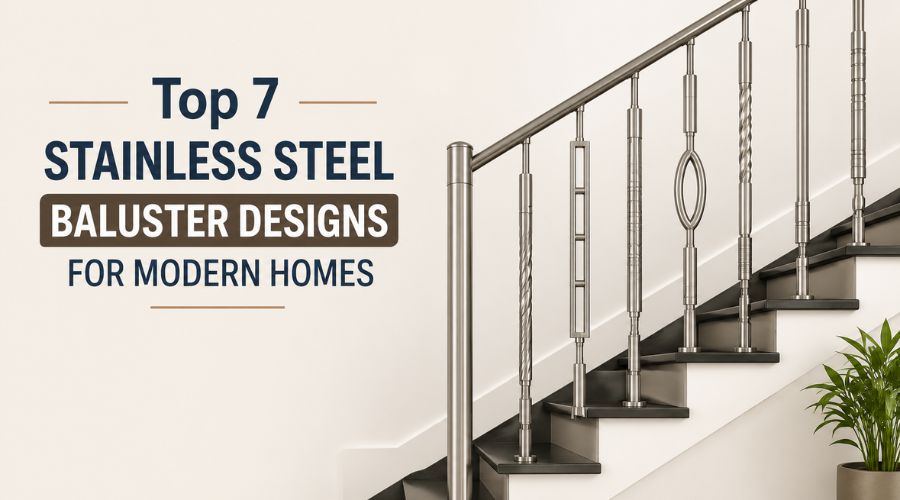
Seven patterns cover most of what architects specify for stainless steel stair balusters right now, each answering a different mix of sightline, load, and budget.
1. Minimalist Round Balusters
Round tube balusters, 12mm to 16mm in diameter, spread load evenly around their circumference, which is why spacing codes treat them as the reference case for baluster calculations. The rounded profile leaves no edge to catch fabric or skin. In contrast to glass infill, round staircase balusters recede from a distance and let the handrail appear as a single floating line.
2. Square Stainless Steel Balusters
Square profile balusters, 12 mm to 20 mm per side, resist twisting under lateral load better than round tubes of the same wall thickness because their flat faces increase the section’s torsional stiffness. That margin is why square balusters turn up in wider staircases, where each baluster spans a longer unsupported run.
3. Twisted Stainless Steel Balusters
Fabricators cold-form these by rotating a square or hexagonal bar under controlled torque, which work-hardens the surface without weakening the core. The twist holds permanently, unlike a bend that can relax back over years of thermal cycling. These decorative stainless steel balusters suit staircases built to be noticed, not just used.
4. Laser Cut Designer Balusters
Laser cutting removes material from a flat stainless steel panel with a kerf under 0.2mm, tight enough to reproduce fine patterns without the ragged edge plasma or waterjet cutting can leave. Because the pattern runs from a digital file, every panel in a batch repeats with identical spacing, which justifies the higher cost per panel on architectural projects.
5. Glass and Stainless Steel Combination
Toughened glass infill, 10mm or 12mm laminated safety glass, sits inside a steel channel or clamps between spigots spaced roughly 700mm to 1000mm apart. Dropping the vertical balusters opens the sightline through the staircase and lets daylight reach further into a stairwell that would otherwise remain in shadow.
6. Wooden Handrail with SS Balusters
A timber handrail on SS balusters puts a low-conductivity surface where a hand actually grips, since wood transfers less heat than bare metal in an unheated stairwell. The steel below carries the structural load and keeps the profile slim, which is why renovation projects favor this pairing when modernizing without stripping out the original material.
7. Cable Style Stainless Steel Balusters
Horizontal cable infill, 3mm or 4mm 1×19 strand wire rope, replaces vertical balusters and runs through drilled holes in the newel posts under tension. Each run needs re-tensioning once a year, since the wire stretches slightly under load. Codes cap horizontal cable spacing tighter than vertical contemporary baluster designs, since a horizontal run is easier to climb.
How to Choose the Right SS Baluster Design
Matching a design to a project requires a few checks before ordering. Interior style sets the starting point: round balusters suit a minimal interior, and laser-cut panels suit a space built around a stronger visual statement.
Staircase width and run length decide how many balusters or spigots it requires, and that count moves the budget more than the profile choice does. Safety codes cap infill gaps at 100mm, and minimum handrail height sits at 900mm above the nosing line.
Finish affects how the staircase looks after five years. A mirror polish shows fingerprints and scratches more quickly than a brushed or satin finish. Outdoor or coastal jobs should specify grade 316 over 304, regardless of budget, since pitting near salt air can start on 304 within a few years.
Cost tracks fabrication complexity: round tubes sit at the low end, laser-cut panels at the high end, with cable and glass in between depending on spigot count.
Bringing It Together
Every one of these seven patterns solves the same two problems from a different angle: how the staircase looks, and whether it holds up structurally for decades without maintenance headaches. Modern stair railing design rarely involves choosing the pattern that photographs best. The key is matching diameter, spacing, and grade to the staircase’s actual conditions, indoor or outdoor, coastal or inland. Get those specifications right, and the stainless steel baluster designs on the shortlist will still perform the same way a decade from now.